Professional Topographical Survey Services

BLOG
Understanding Topographical Surveys

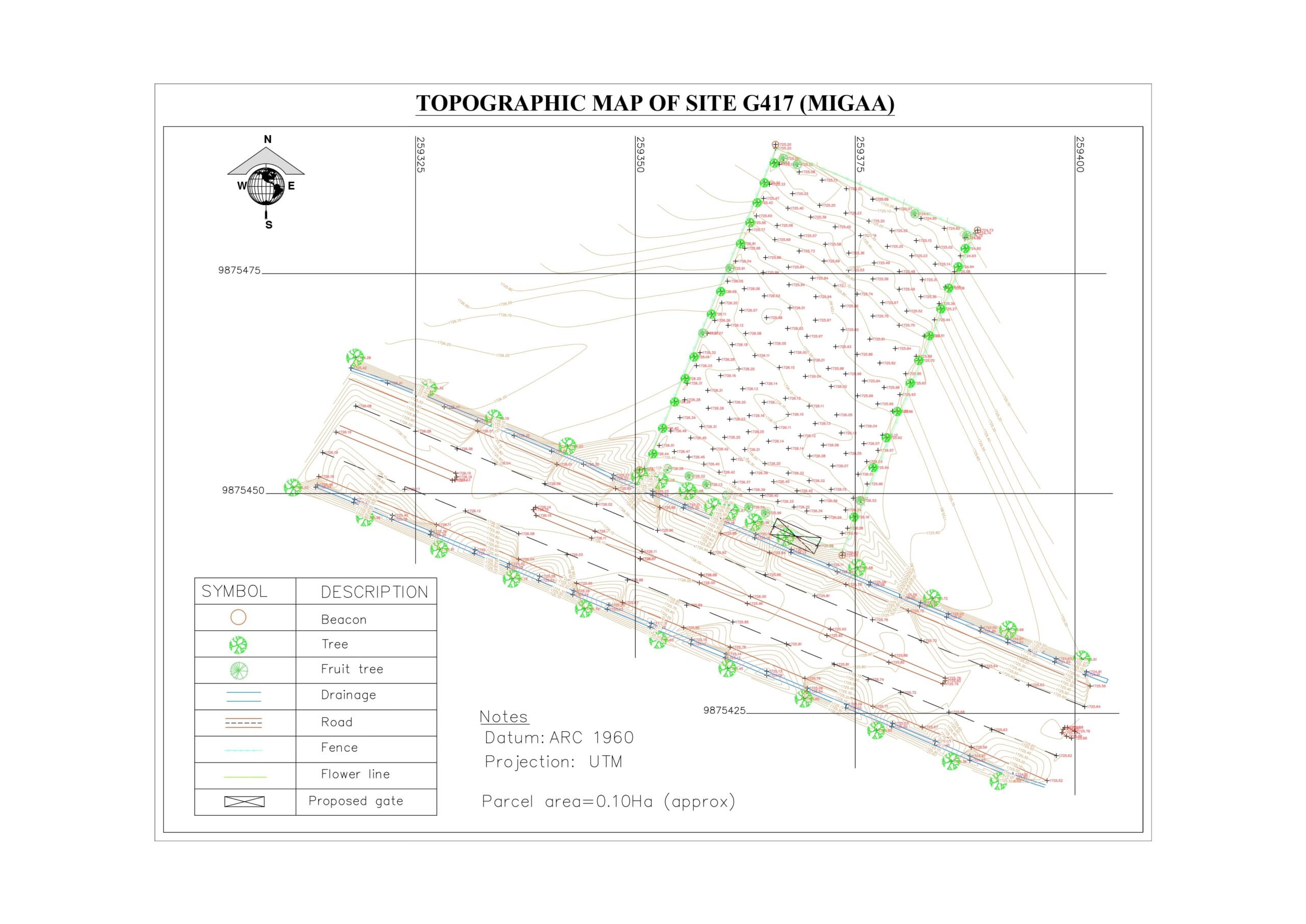
A topographical survey provides an accurate, scaled depiction of natural and man-made features of a given site. These include buildings, fences, contours, trees, and water bodies, with precise elevations and spatial data (coordinates, bearings, distances). Such surveys form the foundation for effective planning in construction, drainage design, grading, and more. A detailed topographical map illustrates terrain relief through contour lines or spot elevations, serving as a critical tool for engineering and planning projects.

Key Objectives of Topographical Surveys
  1. Comprehensive Site Analysis: Capturing detailed spatial data about the natural and built environment of a site.
  2. Accurate Planning: Providing essential inputs for the design of infrastructure, such as drainage systems, grading plans, and utility layouts.
  3. Integration with National Systems: Aligning survey data with national grids and standards to ensure consistency and regulatory compliance.
  4. 3D Modeling and Visualization: Enabling advanced simulations and visual representations to support stakeholder communication and project evaluation.
Our Expertise in Topographical Survey Services

At Ortho Map Solutions, we specialize in providing accurate and reliable topographical survey services across Kenya and the East Africa region. Our expertise ensures the accurate collection and mapping of spatial data, equipping project teams with actionable insights to drive informed decision-making.

Our commitment to quality ensures regulatory compliance, enhances operational efficiency, and mitigates risks—helping you avoid costly errors and delays while achieving your project objectives seamlessly.

Requirements for Conducting Topographical Surveys
Methods of Conducting Topographical Surveys
Topographical Survey Process: Step-by-Step
  1. Preliminary Reconnaissance: Conduct site visits to assess terrain conditions, establish control points, and identify potential challenges.
  2. Control Points Establishment: Horizontal and vertical controls are set using static survey methods, followed by post-processing for accuracy.
  3. Data Collection: Features are recorded in 3D (x, y, z) using GNSS or total stations, ensuring precise alignment with control points.
  4. Data Processing: Survey data is processed with software like AutoCAD Civil 3D to generate outputs such as contours, DTMs, DEMs, and cross-sections.
  5. Deliverable Preparation: Consider client specifications, contour intervals, and map scale while finalizing the topographical map.
Deliverables from a Topographical Survey
  • Observation Data: Coordinates and accuracy levels presented in spreadsheets or similar formats.
  • Topographical Maps: Scaled maps tailored to the client’s requirements, typically at 1:500, 1:1000, or 1:2500.
  • Profiles: Longitudinal and cross-sectional profiles for engineering designs like pipelines and sewer lines.
  • Technical Reports: Comprehensive documentation on fieldwork, data processing, and survey methodologies.
  • Additional Outputs: Photos, accuracy sheets, and survey adjustment records for static surveys.
Why Choose Ortho Map Solutions?

At Ortho Map Solutions, we bring years of expertise and professionalism to topographical surveys. Let us help you navigate your project’s complexities with accurate data and reliable insights. Contact us today to learn more about our services and how we can assist your next project.

Tags :
BLOG
Share This :

Subscribe Our Newsletter

Subscribe to our newsletter for exclusive insights into how cutting-edge geospatial solutions are driving innovation and transforming industries.

Categories